
What’s the Average Cost Per Lead for Coaching Businesses?
One of the most common questions coaches ask when they start running Facebook and Instagram ads is:
“What should my cost per lead be?”
It’s a good question… but it’s also one of the easiest metrics to misunderstand.
The honest answer is:
The average cost per lead for coaching businesses can range anywhere from under $1 to $20+ per lead depending on the niche, offer, funnel, audience, and quality of the lead.
But here’s the more important truth:
A cheaper lead is not always a better lead.
At Grow Automate Scale, we don’t look at cost per lead by itself. We look at what happens after someone becomes a lead.
Do they open the emails?
Do they watch the training?
Do they buy the low-ticket offer?
Do they register for the webinar?
Do they book a call?
Do they show buying intent?
Do they eventually turn into revenue?
Because if leads are cheap but they don’t convert, they are not really helping your coaching business grow.
Cost Per Lead Depends on the Niche
One of the biggest factors that affects cost per lead is the niche you’re targeting.
Some niches naturally generate very low-cost leads because the topic has broad appeal, low resistance, or a strong hobby/passion angle.
For example, one of our clients owns an art studio and started running digital programs targeting people interested in pastel art.
The lead costs were very low, coming in under $3 per lead.
But what made that campaign especially strong was not just the low cost per lead.
It was the funnel behind it.
After someone opted in, they were immediately offered one of her most popular classes for 50% off. This was positioned as a fast-action offer on the thank-you page.
That meant the campaign was not just building an email list.
It was also generating buyers.
That funnel was producing a 1 to 2x return on ad spend immediately once the sales funnel was updated to drive sales, not just leads.
This is why context matters.
A low cost per lead is great when the funnel is also producing revenue.
But a low cost per lead is not impressive if the leads never buy.
Higher Cost Per Lead Can Still Be Profitable
On the other side, we’ve also seen coaching and education funnels where the cost per lead was much higher.
In one evergreen webinar funnel, the cost per lead was around $15 to $20.
At first glance, some people might think that’s too high.
That would be true IF we were just looking at the cost per lead.
Why?
Because people were purchasing from the webinar, and about 90% of the buyers were coming directly through the fast-action bonus.
Even with the higher cost per lead, the funnel was consistently generating around a 2x+ return on ad spend on a mid-ticket offer.
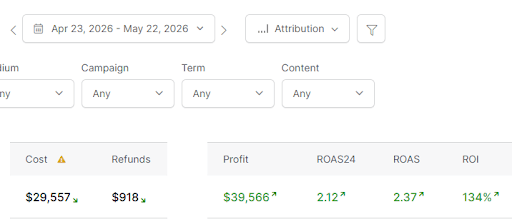
That is why you cannot judge ad performance based on cost per lead alone.
A $20 lead that turns into revenue can be much more valuable than a $2 lead that never buys.
The Real Question Is Not “What’s My CPL?”
The better question is:
“What is my cost per qualified lead?”
Or even better:
“What is my cost per buyer, booked call, or sale?”
Because in coaching businesses, the lead itself is only the first step.
The real value comes from what that lead does next.
A lead who downloads a free guide and never opens another email is very different from a lead who:
Watches your training
Clicks through to your offer
Books a call
Shows up to the call
Asks buying questions
Or purchases a low-ticket offer
upsell into your membership
and becomes recurring revenue.
Both are technically “leads.”
But they are not equal in value.
This is why we tell clients to look at post-click behavior.
What happens after someone clicks the ad?
What happens after they opt in?
What actions are they taking?
Those answers tell us whether we are attracting real prospects or just filling the list with tire kickers.
Why Cheap Leads Can Be Misleading
A lot of coaching businesses get excited when they see cheap leads.
And we get it.
Seeing a low cost per lead feels good.
But sometimes cheap leads are cheap for a reason.
They may be curious, but not committed.
They may want free information, but not be willing to invest.
They may opt in quickly, but never move deeper into the funnel.
They may not be the right fit for the offer.
We’ve seen campaigns where the cost per lead was extremely low, but the backend conversions were weak.
In those situations, the solution was not to keep chasing cheaper leads.
The solution was to tighten the messaging.
We made the ads more specific.
We aligned the copy more closely with the actual buyer.
We narrowed the message so it spoke to the right person, not just anyone who might be interested.
When we did that, the cost per lead went up.
But the quality of the leads improved.
More people started buying.
That’s a tradeoff we are usually willing to make.
Because the goal is not to get the cheapest leads possible.
The goal is to get leads that can turn into revenue.
A Good Rule of Thumb for Cost Per Lead
One benchmark we like to use is this:
Your cost per lead should ideally be around one-fourth of your earnings per lead.
So if your cost per lead is $10, you want to be earning around $40 per lead.
That gives you a much healthier margin and helps you understand whether your lead costs are sustainable.
For example:
If your CPL is $5, you want your earnings per lead to be around $20.
If your CPL is $10, you want your earnings per lead to be around $40.
If your CPL is $20, you want your earnings per lead to be around $80.
This does not mean every funnel will hit this perfectly right away.
But it gives you a simple way to understand whether your lead costs are supporting profitability.
Because a $15 CPL may be great if your earnings per lead are $75.
But a $5 CPL may be a problem if your earnings per lead are only $3.
What We Look At Before Deciding If a CPL Is “Good”
When Grow Automate Scale looks at a coaching ad campaign, we don’t start by asking, “Is the cost per lead low?”
We ask:
What is the offer?
What is the funnel?
What is the price point?
What is the conversion rate?
What is the landing page conversion rate?
What is the offer conversion rate?
What is the earnings per lead?
What is the return on ad spend?
Are leads turning into sales?
Are we able to scale while maintaining profitability?
This matters because cost per lead is only one part of the equation.
If the landing page conversion rate is strong, but the offer conversion rate is weak, the problem may not be the ad.
If the leads are cheap, but no one buys, the issue may be lead quality.
If the leads are more expensive, but buyers are coming in consistently, the campaign may actually be healthier than it looks on the surface.
That’s why cost per lead should never be reviewed in isolation.
How Long Does It Take to Optimize Cost Per Lead?
In most cases, it can take about 4 to 8 weeks to fully optimize cost per lead.
That timeline depends heavily on budget.
A campaign with a larger daily budget can gather data faster.
A campaign with a smaller budget may need more time to generate enough clicks, leads, and conversions to make smart decisions.
During that optimization period, we are looking at things like:
Which hooks are getting attention?
Which creatives are producing quality leads?
Which audiences are responding?
Which landing pages are converting?
Which leads are taking action after opting in?
Which campaigns are producing revenue?
Optimization is not just about lowering the cost per lead.
It is about improving the quality of the traffic, the performance of the funnel, and the return on ad spend.
When a Higher CPL Is Actually a Good Sign
There are times when a higher cost per lead is actually a step in the right direction.
That may sound strange, but it happens often.
If you make your messaging more specific, you may attract fewer people overall.
But the people who do opt in may be much more aligned with your offer.
For example, a vague ad might attract a broad audience and generate cheap leads.
But a more specific ad that calls out the exact pain, desire, or identity of the buyer may cost more per lead.
That higher CPL can still be a win if those leads:
Are more engaged
Are more qualified
Are more likely to buy
Have stronger buying intent
Move through the funnel faster
This is especially important for higher-ticket coaching programs, evergreen webinars, launches, and offers where lead quality matters more than lead volume.
So… What Is a Good CPL for Coaching Businesses?
A “good” CPL depends on the business model.
For some coaching businesses, a $3 lead can be great.
For others, a $20 lead can be profitable.
The real question is not:
“What is the average cost per lead?”
The real question is:
“Can we turn those leads into revenue profitably?”
If your leads are converting into buyers, calls, clients, or sales, then your CPL may be perfectly fine, even if it is higher than what you expected.
If your leads are cheap but not converting, then the campaign needs deeper review.
The Bottom Line
Cost per lead matters.
But it is not the final metric.
At Grow Automate Scale, we care about whether the full system is working.
That includes:
✅ The ad
✅ The landing page
✅ The offer
✅ The follow-up
✅ The sales process
✅ The conversion rates
✅ The revenue
✅ The return on ad spend
Because your ads are not just there to get leads.
They are there to support growth.
A low CPL may feel exciting, but it only matters if those leads are helping the business move forward.
A higher CPL may feel uncomfortable, but it may be completely worth it if those leads are turning into real buyers.
The goal is not the cheapest lead.
The goal is the right lead at a cost that still allows your business to grow profitably.
Want Help Understanding Your Real Cost Per Lead?
If you’re already running ads and you’re not sure whether your lead costs are actually healthy, Grow Automate Scale can help you look at the full picture.
We’ll review your ads, funnel, offer, and numbers to help you understand:
👉 What’s working
👉 What’s leaking
👉 Whether your CPL is actually a problem
👉 What needs to be fixed before increasing ad spend
👉 Where the real opportunities are for growth
Book a Scale With Ads Call with Grow Automate Scale and we’ll help you map out what your numbers are really telling you.
Disclaimer: Client Results & Earnings
At Grow Automate Scale, we are committed to providing expert digital marketing strategies, advertising management, and consulting services to help businesses grow. However, individual results will vary, and we do not guarantee specific outcomes, earnings, or business success.
While our clients have achieved significant growth using our strategies, success depends on various factors, including market conditions, business model, offer quality, audience targeting, ad budget, and client implementation. Any examples, case studies, or testimonials shared on our website, social media, or marketing materials are not guarantees of future results.
By using our services, you acknowledge that Grow Automate Scale is not responsible for your financial decisions, ad performance, or business results. Marketing and advertising involve inherent risks, and you understand that past success does not guarantee future performance.


Disclaimer: Client Results & Earnings
At Grow Automate Scale, we are committed to providing expert digital marketing strategies, advertising management, and consulting services to help businesses grow. However, individual results will vary, and we do not guarantee specific outcomes, earnings, or business success.
While our clients have achieved significant growth using our strategies, success depends on various factors, including market conditions, business model, offer quality, audience targeting, ad budget, and client implementation. Any examples, case studies, or testimonials shared on our website, social media, or marketing materials are not guarantees of future results.
By using our services, you acknowledge that Grow Automate Scale is not responsible for your financial decisions, ad performance, or business results. Marketing and advertising involve inherent risks, and you understand that past success does not guarantee future performance.